
Better measurement starts with asking the right question
Health and aging are complex. We believe measurement technologies should be evaluated according to what they actually measure, the evidence supporting them, and how the information can meaningfully be used.
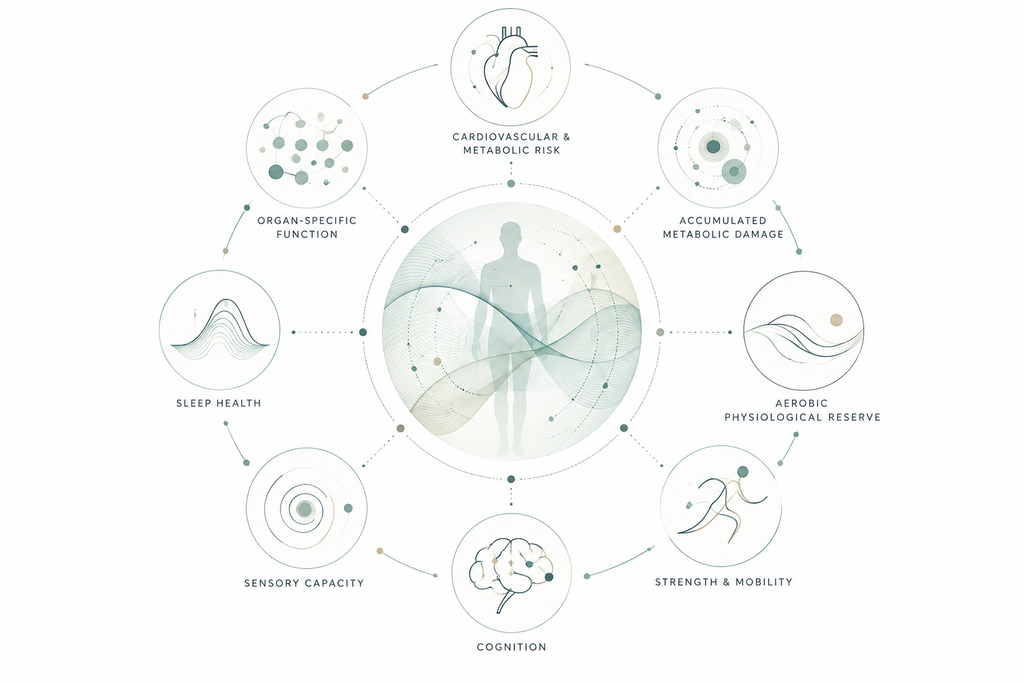
There is no single measurement of aging
Aging involves changes across multiple biological, physiological, and functional systems. Cardiometabolic and vascular health, muscle and mobility, cardiorespiratory reserve, cognition, sensory function, sleep, and organ function can follow different trajectories within the same person.
For that reason, we are cautious about claims that any single measurement universally captures a person’s “biological age.”
Illustrative dimensions; not a taxonomy of ABS products or services.
Measurement is not the same as diagnosis
A technology can provide useful information without being a diagnostic test. But understanding what kind of information it provides is essential.
What is being measured?
- Physiological measurement
- Functional assessment
- Imaging or structural measurement
- Wellness measurement
What does the evidence support?
- Screening or diagnostic use
- Prognostic or risk-stratification use
- Monitoring use
- Predictive use
These concepts are not interchangeable. A measurement may support one or more uses, and the strength of evidence may differ by population and setting.
The questions we ask
1.
What exactly is being measured?
2.
What is the biological basis?
3.
In which populations has the measurement been validated?
4.
What health or functional outcomes is it associated with?
5.
Can it be implemented practically?
6.
Can it be measured longitudinally?
7.
Does it complement other measurements, or largely duplicate them?
Measure different dimensions. Build a more complete picture.
More data are not automatically better. Measurements are most valuable when their meaning, limitations, and relationship to other information are understood.
Our long-term direction is therefore not to search for one universal metric of aging, but to identify complementary technologies that can characterize different dimensions of health and physiology.